
Commercial Waste Stratford — Recycling and Sustainability
Welcome to our overview of Commercial Waste Stratford sustainability practices. This page explains how commercial waste in Stratford is managed with an emphasis on an eco-friendly waste disposal area and a resilient sustainable rubbish area model. We outline our recycling percentage target, collaborations with local transfer stations, charity partnerships for reuse, and investments in low-carbon vans to reduce transport emissions. Our approach is practical, repeatable and tailored to the borough’s recycling and waste-separation standards.We support businesses across Stratford and neighbouring boroughs by providing clear segregation guidance and practical services. The borough approach to waste separation encourages businesses to separate glass, paper/card, metal cans, food waste and garden waste from residual streams — a system that underpins all of our commercial waste services in Stratford. By combining local policy alignment with operator experience, we ensure waste leaves sites ready for reuse, recycling or safe disposal.
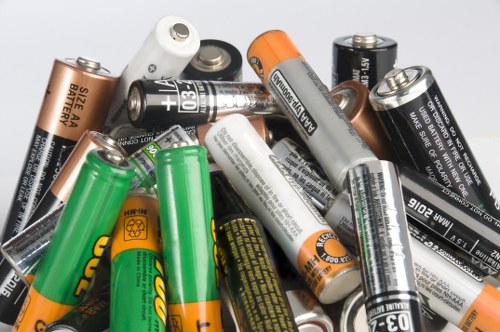 Our recycling percentage target is ambitious but achievable: we aim to recycle 70% of collected commercial waste within five years across our Stratford operations. This target reflects an emphasis on reducing landfill, increasing recovery rates and improving the quality of recyclable materials leaving the site. To hit this benchmark we monitor tonnages, contamination rates and route efficiency, and we report progress using transparent metrics tailored to each client.
To support on-the-ground sorting, we operate dedicated sections of our eco-friendly waste disposal area for different material streams. Typical on-site segregation points include:
- Glass banks for bottles and jars
- Paper and cardboard baling areas for cardboard recycling
- Food waste containers for anaerobic digestion
- Mixed dry recycling for cans, plastics and mixed packaging
Through these practical setups, businesses find moving to a sustainable rubbish area straightforward. Staff training, clear signage and scheduled collections support compliance, and we provide bespoke advice to fit each site’s footprint and trade profile.
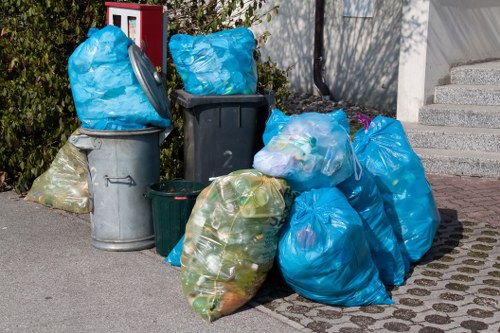 We also coordinate with local transfer stations to optimise routes and reduce double handling. By using nearby transfer facilities and East London transfer stations where appropriate, we keep haulage distances low and improve material consolidation for onward recycling. These transfer hubs enable better sorting, densification and onward delivery to reprocessing plants, which in turn raises recycling yields for local commercial waste in Stratford.
Partnerships with Charities and Reuse Organisations
One of the most effective ways to boost recycling and resource recovery is through partnerships with charities and reuse organisations. We work with local furniture reuse charities, food redistribution networks and community groups to divert usable items from the waste stream. Where businesses need to dispose of surplus fixtures, fittings or catering equipment, we prioritise donation pathways before considering recycling or disposal. This approach supports a circular economy in Stratford and nearby boroughs.Sustainable Logistics: Low-Carbon Vans and Fleet Strategy
Our collection fleet includes low-carbon vans — electric and plug-in hybrid models — that service the Stratford area. Using low-emission vehicles for short urban trips reduces air pollution and aligns with borough-level carbon reduction goals. Combined with efficient scheduling and route consolidation, these vehicles lower the carbon intensity of commercial waste collection while maintaining reliable service for businesses.Specific recycling activities relevant to the area include targeted cardboard and paper recycling for retail and hospitality, segregated food waste collections for restaurants and caterers, and construction & demolition segregation for small builders working in Stratford developments. The borough’s mixed recycling programmes mean we tailor collections to local systems: kerbside-like commingled collections where suitable, or separated streams where required to meet quality targets.
Our sustainable rubbish area design emphasises durability and adaptability. We provide lockable containers, weatherproof bays and clear labelling for each stream, together with training materials that help staff understand why each bin exists. Regular contamination checks and feedback loops reduce cross-stream contamination and improve overall recycling rates.
We maintain formal agreements with transfer stations and inbound reprocessors to ensure materials are handled consistently. These relationships allow us to offer businesses transparency about material destinations and to prioritise higher-value recycling routes over lower-value disposal. Reporting includes tonnage breakdowns by stream, contamination percentages and progress against the 70% recycling ambition.
 Working with the local council and community partners, we support borough-wide initiatives to improve separation at source. Educational campaigns for small and medium enterprises, seasonal waste reduction drives and collaborative reuse events are all part of the wider programme to embed sustainable waste behaviour across Stratford.
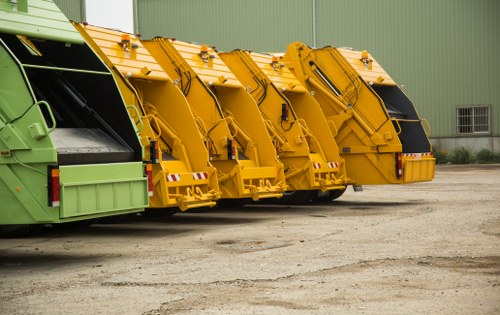 In conclusion, our integrated model for eco-friendly waste disposal in Stratford and a robust sustainable rubbish area offers businesses a pragmatic path to better recycling outcomes. With a clear recycling percentage target, strong transfer-station links, charity partnerships for reuse and a low-carbon van fleet, Commercial Waste Stratford is positioned to help local businesses meet environmental obligations while contributing to a cleaner, greener borough.
